
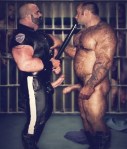
Jack looked at the package he’d received in the mail, puzzled. He’d gotten hired on as a prison guard the week before, and his first shift was tonight, but he’d been expecting a uniform in the mail, but when he’d opened the box, the only thing that he’d found inside was a pair of leather boots with some black, uniform socks. Where was his shirt and pants? Figuring it was just a mistake, he tried to call the prison and ask, but his manager wasn’t on duty, and so he figured he might as well wear his normal clothes and the boots–they could probably find a spare for him when he went in to start his shift.

He pulled on the socks and boots, and realized that they were also massively oversized for his feet. He usually wore a ten and a half, but when he checked the tongue of the shoe, the boots were marked as seventeen. They were almost comical on him, when he stood up and tried to walk around, they threatened to slip off. However, after tromping around for a few seconds, he went to try and pull them off, and discovered something strange. His feet had started tingling, and by the time he’d sat down again, the boots fit him just fine.

It fact, they fit too well, and he couldn’t even get the boot off of his foot. Had they shrunk? No–when he looked at them again, he realized that, somehow, his feet had grown, and were still tingling–and the tingle was spreading up his legs and all over his body now, accompanied by a strange heat deep within his body, and a sudden sexual arousal greater than anything he’d ever experienced, so strong that he just slumped back against the couch, feeling his muscles start to pulse and expand as he pawed open the crotch of his jeans and hauled out his cock, the shaft expanding and throbbing along with the rest of him, and he stroked the nine inch shaft, shivering.

The fantasy came unbidden. He was in the jail, and the prisoner in front of him, naked aside from his boots, and Jack was facing him, his chest out, and he could smell the musk rolling off him in the hot prison, and the prisoner could smell it too, could sense his authority, and he reached out, feeling his massive pec in awe of him. He ran his baton down the prisoner’s body, using it to lift up his cock and inspect him, and the man shivered, and fell to his knees, licking his lips in front of Jack’s huge tool. “P–Please sir…” he said, his mouth dry.

“Go on then fucker, suck me dry,” Jack heard himself say, gruff and dismissive, and on the couch, as he imagined the prisoner giving him head, he felt his clothes stretch against his body, hardening into a leather uniform like the one from his fantasy, and as he thought about face fucking the prison bitch, he came, his orgasm sprouting hair all over his body, finishing with a full beard as the hair on his head disappeared, leaving a shiny dome. His old life behind him now, Jack stood up and shoved his huge cock down one leg of his pants, and left his apartment, never to return, a prison guard for life.

Do you have any perticular ideals concerning the depth an author gives to a system that plays a key point in a story? An example being, magic; does it need a certian amount of depth, or can it be an answer to something that doesn’t concern the plot heavily? Ect.

That’s a really big question, and one I think I’ll save for a metawriting entry, but here’s a light discussion of the matter. However, the short answer is that a system should be robust enough that no action becomes deus ex machina. However, the system itself needs to avoid becoming too complex, because then the system overwhelms the narrative. 

Think of it like a video game. Video games have rules–programming rather–which determine how characters within them operate. If those rules are too shallow, we as players are often thrown out of the realism, say, when we come across doors that don’t open, invisible walls, weapons we can’t operate for inane reasons. These poorly defined rules–i.e. they apply where they reasonably shouldn’t, or vice versa–are poorly defined systems.

On the other hand, a system which becomes too complex overwhelms the narrative itself, or becomes the reason for the games existence. In some cases, such as simulation games, this might be appropriate. However, when there are too many rules to abide by, or rules are created arbitrarily to simply flummox the player, these overly complex systems can be just as game-breaking as poorly defined systems are. 

There is, as in all things, a sweet spot. Keeping with the games metaphor, one of the few I’ve seen which hits the sweet spot perfectly is this little gem called Spelunky. It’s a rougelike dungeon crawler, but the rules are simple, and apply universally. Does an arrow trap trigger when you fall it its line if sight? Then it will trigger when anything falls in its line of sight. It is a game that allows for unforeseen consequences of actions that ought to be predictable, but those consequences always result from a system which is transparent and understandable.  

The lights came on overhead in the plane cabin as the fasten seatbelt sign turned off, and you jostled awake, the older gentleman next to you said, “Alright slave, let’s get off this plane and go home.”

You look at him, a bit confused, but he stands up and jerks the chain connected to the heavy metal collar around your neck, and you stand up, abandoning your briefcase underneath the seat in front of you as he leads you down the aisle of the plane, and no one is looking at the two of you like anything strange is happening at all, but this isn’t right, you’re not someone’s slave–you were on your way home from a business trip, right?

You exit the plane, and the man leads you to the bathroom, pulling you behind him, where he forces you onto your knees next to the bank of urinals, unzips his pants and unloads a massive load of piss all over your face, and unable to do anything else, you try and swallow as much as you can, like you’ve been trained to do, and then you kiss the head of his cock in mute thanks. He yanks you up by the collar and you follow him out of the restroom, but before you get to the door you catch sight of yourself in the mirror, and a sickening twist shoots through you, when you don’t even recognize your reflection. Your hair–all of your hair is gone. You’d had a full head of hair, and a beard when you’d boarded the plane, but now it was gone– all of it freshly shaved off, and a huge ring had appeared in your septum. Your business suit was gone, replaced by a simple, grubby tank, yellowed with your master’s cum and piss, and a pair of jean shorts–the only two pieces of clothing the master allows you to wear in public.

Master yanks your chain, and you hurry to follow him, knowing your lapse in attention will warrant punishment when you get home, but you don’t live with this man, do you? This fat old fuck? This…this beautiful man, who you’re honored to serve? Who you’ve loyally served for years now? You love him, and you know he only tolerates you, but you don’t care, simply being in his presence is enough for you, and you’d get hard if your cock wasn’t locked away within your grubby shorts.

You collect the master’s baggage for him at the claim, and then the two of you take a taxi from the airport to master’s house. The cabbie doesn’t seem to think it the least bit odd that you spend the entire ride with your master’s cock down your throat. In fact, master offers the cabbie your throat as a tip, and the Arab man takes him up on his offer, face fucking you quickly and feeding you his cum as well, before driving off.

Something happened on that plane–you know it did. But there’s nothing you can do now. Now, all you can dream of serving him, this is your life and your purpose. Maybe you’ll never know, but it isn’t a slave’s place to think. It isn’t a slave’s place to wonder. A slave’s place is to serve.

Care to give out any examples of female characters in a medieval fantasy setting who and why actually meet the criteria in your opinion?

Martin’s are the best/closest I’ve seen. But that doesn’t make them perfect strong female characters. I’m happy to congratulate Martin on what he’s done, as I’ve noted, but that doesn’t mean I’m going to let his work skate by just because it’s better than everything else that came before, which is a pretty damn low bar, as I noted.

The only reason the humiliation took place was because she agreed to go through with it due to her delusions of grandeur. I feel that reading it as some sort of degradation is very shallow, in reality it was the first moment for her that grounded her in reality and made her realize that her royal bloodline doesn’t mean much at the end of the day as she’s no different from her subjects.

In response to both of the questions you put in, I, quite frankly, don’t care about this as much as you do. I don’t quite understand why you feel so invested in defending Martin as some apex of strong female characters. He’s a fine step in the right direction, and he certainly cares about writing as strong of women as he can, and he succeeds where many other authors have failed, and/or simply not tried at all. 

That said, I’m sorry, but I don’t think George R.R. Martin’s works can be held up to the same level as those of Erica Jong and Jeanette Winterson, and I don’t think any amount of back and forth will convince either one of us of much of anything. Literature still has a long way to go towards any sort of equality, and I’m not going to rest laurels on Martin for doing a job better than anyone else. In spite of all of this argument, if our expectations are so low that Cersei Lannister can meet them, then we can applaud that effort sure, but maybe we also need to raise them up a little bit higher.

You omitted her tremendous daddy issues and the inferiority she feels towards her brother as a woman. Two of her probably most major and character defining traits.

If those traits are supposed to make me more confident in her as a “strong” female character, you aren’t succeeding. Maybe try a woman who isn’t defined in relation to the men in her life, and you’ll be a bit closer. I don’t think you quite understand the criteria that flowchart lays out, so let me elaborate.

Can she carry her own story? She pretty much fails this one, given the fact that she is defined by her relationship to the men in her family. She can’t carry her own story, because the thing driving her isn’t anything internal to her–it’s reactionary towards men. It implies that the only sort of thing that can drive a woman forward are things that men do. Alternatively, if she were driven, say, by her own goals, by her own desires, capable of being defined outside of her relation to men, then she would pass this criteria.

Is she three-dimensional? This is hardest to pin down, but personally, I always think of three dimensionality as a character’s capacity for change and depth. The only sort of change she goes through is her humiliation, which comes about as a punishment for her reckless sexuality (because certainly a woman can’t be punished for anything else). This isn’t change, this is degradation.

Does she represent an idea? She is, in essence, hysteria, and represents a repressed female violence and resentment towards patriarchy. Just because that’s a feminist-ish sounding idea doesn’t make her any less empty as an actual person. It also makes her eventual humiliation far more harsh, as it rebukes that idea, rendering her meek. 

Does she have any flaws? She sure does. She got one!

Does that make sense? I hope I’ve made myself clearer.